 View All Bench Cards
A Practice Guide: Making Child Support Orders Realistic and Enforceable
Download Bench CardOverview
Federal child support legislation dates back to the early 1950s. The genesis of the child support program arose from a series of amendments to the Social Security Act in the late 1960s, providing States with access to information held by the IRS and the Social Security Administration to locate noncustodial parents. State welfare agencies were required to establish a single unit to collect child support and establish paternity for children receiving public assistance benefits. States were obligated to cooperate with one another in child support matters. The Child Support Enforcement program was officially established under Title IV-D of the Social Security Act when President Ford signed P.L. 93-647 (“Child Support Amendments of 1974) on January 4, 1975. Congress has expanded and enhanced the IV-D program in the intervening decades; its current statutory provisions are set out in 42 U.S.C. §§651 – 669B. Regulations governing the administration of this Federal/State/local program, issued by the Federal Office of Child Support Enforcement, are contained in 45 CFR, Parts 301 through 310.
The OCSE website, with links to all relevant statutory and regulatory provisions, as well as OCSE policy documents is found at: http://www.acf.hhs.gov/programs/cse/pol/
Making Child Support Orders Realistic and Enforceable
Twenty-six percent of American children under the age of 18 are growing up in single parent households. An additional fifteen percent live in blended families.1 Absence of a parent is the leading cause of poverty among children; absence of a parent is also increasingly correlated to acts of juvenile delinquency. High rates of divorce, separation, and out-ofwedlock birth have transformed the setting in which children are raised. This overwhelms the courts, child support agency and the welfare system.
Congress established the Federal/State/local Child Support Enforcement Program in 1975, created under Part D, Title IV of the Social Security Act (and hence referred to as the “IV-D Program”). This Federal-State partnership has been increasingly effective at collecting child support. More than 17 million children and their families received $24 billion in child support in 2006 through the help of the Child Support Enforcement Program. The Federal Office of Child Support Enforcement (OCSE) Preliminary Report for fiscal year (FY) 2006 also reports that over 1.2 million child support orders were established and 1.7 million paternities were established and acknowledged.2
State courts are inextricably intertwined with the success and perceived justice of the child support enforcement system. With powerful and largely administrative enforcement tools3 in place, research and policy debates have refocused on key decision points that appear to make a critical difference in ensuring child support is the economic linchpin to family self-sufficiency that the Personal Responsibility and Work Opportunity Reconciliation Act of 1996 (PRWORA or “Welfare Reform”) intended it to be.
Recent research categorized a major portion of child support arrears as being owed by “dead broke,” not “dead beat,” dads.4 Considerations growing from this and similar studies include whether the all too common practice of entering default orders based on minimum orders or hypothetical earning capacity and ordered retroactively (often years) to the child’s birth is in the interest of the litigants, the child, the court or the child support enforcement system. While legally permissible, these orders are now believed to create an insurmountable roadblock to compliance. Overwhelmed by a debt that will never be paid (particularly when coupled with interest or penalty charges), the obligor abandons any attempt at payment and the IV-D program is saddled with larger arrears and poorer performance statistics.
While arrears and nonpayment of support orders will always exist, the development of successful arrears-prevention policies will facilitate payment of support and help alleviate the overwhelming arrears management problem. The consequences of default orders, retroactive support, minimum obligations or attributed income policies unconnected to the realistic capacity of low-income obligors to meet child support orders are often unrealistic orders that are neither enforced nor realistically enforceable. This benchcard harnesses the realworld experiences of judges to provide a tool that will guide judicial, quasi-judicial and administrative hearing officers alike in making more nuanced decisions at the time the support order is established, avoiding a build-up of unpaid support and establishing child support that is a reliable source of income for families. The following sections examine Retroactive Support, Order Basics, Default Orders, and Child Support Guideline – Determining Income.
Retroactive Support
In addition to establishing a current obligation for child and medical support, the initial order may also set that obligation retroactively, along with assessing legal costs, genetic test costs, birthing costs, fees, and a provision for late-payment charges and/or interest on any or all of the above.
While almost every court makes the order retroactive to at least the date the petition for support was filed with the tribunal, States permit retroactivity for a considerably longer period – perhaps to the child’s birth.1
Courts have an interest in ensuring that a respondent does not gain an advantage or shift a financial burden of a child’s support to the custodian or the State, simply by avoiding litigation. Equally, research has shown that the longer the period of retroactivity, the less likely the parent is to pay.2 Where a noncustodial parent starts off with an order containing large arrears, he or she may view compliance as impossible and participation in the process as pointless. Such a conclusion is reasonable where the law assesses interest on the retroactive support, beginning when it is assessed. Judges also well understand the frustration of facing either a minimum payment on the retroactive support – so that the debt will never be paid over a reasonable period – or such a large sum in addition to current support that the payment will be unenforceable within consumer credit protection limits.
When entering a retroactive support order, the judge should consider the State’s legal requirements and restrictions. In exercising available judicial discretion regarding the period of retroactivity, how retroactive support will be paid, and additional amounts to be charged to the obligor, the Project Advisory Group suggests the following factors be considered:
RETROACTIVE SUPPORT ORDER CHECKLIST
- The reason for the delay in establishing the order. Determine the retroactive period based on case-specific circumstances. Did the noncustodial parent (NCP) know of the existence of the child? Did the custodial parent (CP) and NCP have an informal arrangement during which the NCP contributed directly to the support of the child? Was the delay occasioned by failure to obtain service or a lengthy processing time at the child support agency or in the court? Was the NCP actively avoiding service? Was the NCP out-of-state, in the military or incarcerated? Where not otherwise established by State law, consider articulating a policy standard so similarly situated individuals are treated equitably.
- For any period of retroactivity, the child support guideline must be applied.
- For retroactivity prior to the filing date, determine how payment of this judgment will impact the NCP’s ability to pay ongoing support. Consider appropriate bases for deviation under State law as well as the long-term effect of the amount of retroactive support on the likelihood of it being paid when setting an order involving a lowincome obligor.3
- Set an equitable method of repayment of retroactive support as permitted by State law. However, a periodic payment amount set in the order does not limit the IV-D agency’s right to use other enforcement remedies for qualified past due support, such as use of Federal and State tax refund offset.
- If allowed in your jurisdiction, determine whether and how much the NCP should be ordered to reimburse such expenses as birthing costs (in accord with guidelines) or attorney’s fees, as well as how these “add on” collections should be paid.4
1 A number of States have revised their laws to reduce the period of retroactivity. For example, Texas changed its period of retroactivity from the child’s birth to a maximum of 4 years.
2 “The longer the time for which non-custodial parents are charged retroactive support, the less likely they are to make any payment on their child support order once established.” HHS, Office of the Inspector General, The Establishment of Child Support Orders for Low Income Non-custodial Parents, p13. Available online at http://oig.hhs.gov/oei/reports/oei-05-99-00390.pdf
3 “We know from other research that ordering arrears for periods prior to the date of filing for an order, referred to as retroactive support, contributes to arrears. In Colorado, for example, 19 percent of the arrears consisted of retroactive support. The Colorado Child Support Program estimated that the average amount paid toward retroactive support was $180 per year and that obligors who owed retroactive support would take an average of 39 years to pay off their retroactive support.” p57. [footnotes omitted] Sorensen, Elaine, Sousa, Liliana & Schaner, Simon, Assessing Child Support Arrears in Nine Large States and the Nation (The Urban Institute, 2007). Available online at http://aspe.hhs.gov/hsp/07/assessing-CS-debt/
4 For example, in Rhode Island, birthing and interest costs are negotiable, and the Court has the discretion to stay interest charges.
Order Basics
Legal questions regarding insufficiency or lack of clarity in a different State’s child support order may result in refusal to enforce, inadequate enforcement, second-guessing of terms, or long processing delays. Such issues are multiplied when the case moves from a local matter to an interstate case. The consequences of default orders, retroactive support, minimum obligations, or attributed income policies unconnected to realistic capacity of low-income obligors to meet child support orders may result in orders that are enforceable in theory but fail to ensure that ongoing child support is a reliable source of income for the custodial parent and child. After discussion, the Project Advisory Group recommends that judges consider the following checklist to ensure that all support orders are realistic and realizable.
SUPPORT ORDER CHECKLIST
- Include written finding of basis of personal jurisdiction over obligor, particularly where order is entered by default or asserting jurisdiction over a nonresident.
- Recite due process basics to avoid later challenge, including whether a nonresident party was offered the opportunity to participate by teleconference.
- Include affirmative statement that no other valid support order exists when entering new support order.
- Include written finding showing paternity was determined – by paternity acknowledgment, consent without genetic testing, conclusive presumption, finding after genetic testing.
- Include an analysis of subject matter jurisdiction when modifying (or declining to modify) the order of a sister State.
- Include child support guideline calculation and any finding of basis to deviate.
- Include medical child support (see “Determining Medical Support” worksheet in NCJFCJ’s technical assistance bulletin, Why Medical Child Support is Important—and Complex).
- Include basis of retroactive support and application of child support guideline to retroactive period if appropriate.
- Recognize the validity of pay and employment information from FPLS, without requiring independent employer verification.
- Recite that the requirements of the Servicemembers Civil Relief Act have been met, waived or that the respondent is not a member of the armed services.
- Include direction to pay child support through State Disbursement Unit (SDU) via income withholding and delineate either the Consumer Credit Protection Limit or the factors (another support obligation and/or amount of arrears) that will permit the child support agency or employer to correctly apply Federal and State law.
- Include applicable interest rate or penalties on arrears, if any.
- Include date order terminates or factual circumstances for termination (e.g., high school graduation or change of custody).
- Reconcile consolidated arrears when determining which of pre-existing multiple orders controls current support.
- Direct both CP and NCP to update address, employment and income information.
- Ensure copy of order is sent timely to IV-D agency and parties, to allow for appeal or review request.
- Include a description of the legal basis for later modification of the order.
Default Orders
All State courts have the authority to issue a default order should the respondent fail to appear, provided the court has both subject matter jurisdiction and personal jurisdiction over the respondent, and has provided notice of the hearing.1 While participation of both parties is inherently fairer, when a party fails to appear after receiving proper notice, a default order may be necessary. (However, one California study found that seventy-one percent of child support debtors had at least one order set by default).2 There are two key policy issues caused by default orders. First, default orders are less likely to be paid. Second, default orders are often subject to later challenges on due process grounds, particularly when enforcement is sought in another jurisdiction.
On the other hand, the State has an overriding interest in having the respondent appear at the time the order is established. For courts, respect for the judicial process is foremost. Courts may find it advantageous to review the entire order establishment process to determine the extent to which each segment promotes or undermines this interest. Courts should examine the content of the initial summons and notice. How and by whom is service made? Does the notice accommodate the needs of non-English speaking individuals? What is the time-lapse between service of the petition and notice of the hearing? Does the child support guideline’s default order standard benefit a high-income noncustodial parent (NCP)?
To ensure the fairness of default orders and avoid having the order set aside later, the judge or quasi-judicial official should:
- Make a finding of the basis for jurisdiction. To adjudicate paternity or establish the original support order, personal jurisdiction over the respondent is required. Although personal service may be more cumbersome and time-consuming, ensuring service is constitutionally sufficient and documented will inoculate the order against a later challenge to its validity.
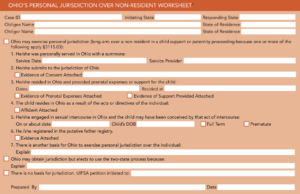
- Review the Uniform Interstate Family Support Act (UIFSA). Where the tribunal is asserting jurisdiction over a non-resident, all States have enacted the UIFSA. Section 201 sets out the bases for extended jurisdiction. Again, the basis for jurisdiction should be expressed in the order. For example, see Ohio’s “Personal Jurisdiction over Non-Resident” worksheet. The 2001 amendments to UIFSA clarify that long-arm jurisdiction is available to establish or enforce a support order. It may not, however, be used to acquire personal jurisdiction for the tribunal to modify another State’s order.
- Consider innovative techniques to raise participation by the respondent. Many advocates believe that the litigants’ perceptions concerning the fairness, openness and comprehensiveness of child support hearings go a long way toward encouraging participation.
- Confirm that the parties have been given notice and the opportunity to appear, and retain proof of service and notice in the court file.
- Appoint counsel pursuant to the Servicemembers Civil Relief Act where the respondent is known or believed to be a member of the armed services.3
- Check to make sure the respondent is not incarcerated.
- Look at other support cases involving the obligor and another family.
- Establish the support order based on actual income of the parties, requesting available information from the child support agency obtained from the Federal Parent Locator Service (FPLS), employer verification, or the petitioner.
- Limit use of default orders where paternity is at issue, unless genetic testing has already been obtained, and use all tools available (warrant/capias) to secure the respondent’s presence and participation in genetic testing.
- Ensure the child support guideline contains standards for setting default orders that balance the needs and interests of lowincome families.
- Consider providing a short opportunity to ask that the order be reconsidered or an opportunity to reopen. Establish follow-up procedures to document that the respondent received a copy of the order and understands its terms.
Getting the Respondent/NCP to Appear
Most States agree that default orders should be avoided whenever possible – and for good reason, since experiential evidence indicates that the payment compliance rate is significantly lower in default cases. Initially, a State may want to calculate the number of default orders as a percentage of all orders issued, in order to determine the extent of the problem in a particular jurisdiction. If this is in fact an issue, the beginning strategy could be the implementation of appropriate prevention techniques that focus on education and outline the negative consequences intrinsic to defaults. Additional strategies to obtain higher participation rates may focus on the format of the summons or notice to appear.
- In Connecticut, the use of “YOU MUST APPEAR” language on the initial notice has increased the appearance rate to ninety percent.
- In Massachusetts, the record is kept open for one year, during which timeframe the default order can be set aside based on updated NCP income information. Maryland has a similar process, as long as the NCP can provide acceptable documentation of income. While in Connecticut, the default record is kept open for four months, permitting the NCP to appear and provide updated income information.
States also need to determine whether or not minimum due process requirements were met before concluding that a failure to appear should result in default – especially when service of process appears questionable. If the NCP is in default, in conjunction with the issuance of a temporary order, a bench warrant can be issued to increase the likelihood of the NCP’s attendance at a subsequent hearing to establish a final order.
Servicemembers Civil Relief Act5
Effective December 19, 2003, Congress replaced the Soldier’s and Sailor’s Civil Relief Act with the Servicemembers Civil Relief Act (SCRA), 50 USC App. §§501 to 596. The new law makes substantial changes in how paternity and child support cases involving a member of the armed forces are to be handled by private attorneys and state child support (IV-D) agencies. Some courts are requiring an Affidavit of Non-Military Service in all cases before entering a default order in child support and paternity cases. For military personnel stationed outside the tribunal’s jurisdiction, courts may consider use of teleconferenced hearings to avoid delays.
Among the major changes are:
- Coverage. In addition to members of the traditional armed forces, reservists and members of the National Guard who are called to active duty for more than 30 days are now covered by the SCRA. Also covered are American citizens who are serving in the armed forces of another country if that nation is allied with the United States in the prosecution of a war or military action.
- Scope. The old law applied only to court proceedings. The new law covers administrative proceedings as well. It does this by defining a court as “a court or an administrative agency of the United States or of any State.”
- Default Orders. When seeking the entry of a default order against a servicemember, the tribunal (court or administrative agency) may not enter a judgment until after it appoints an attorney to represent the defendant. SCRA §201 requires an automatic stay of proceedings be granted in default proceedings if the defendant is in the military service and upon application of counsel or on the court’s own motion, if the court determines that there may be a defense to the action and a defense cannot be presented without the presence of the defendant, or after defense counsel has been unable to contact the defendant or otherwise determine if a Meritorious defense exists. A stay of at least 90 days must be granted. In addition, the request for a stay does not constitute an appearance for jurisdictional purposes and does not constitute a waiver of any substantive or procedural defense.
- Stay of proceedings. At any stage before final judgment, the court (on its own motion) can grant a stay of the proceedings. Alternatively, the servicemember can apply for a stay. The application must include: 1) a letter from the servicemember setting forth why his/her current military duties prevent an appearance and stating a date when he/she will be available; and 2) a letter from the servicemember’s commanding officer stating that the servicemember’s current duties prevent an appearance and that leave is not authorized. If proper documentation is provided, a stay of at least 90 days must be granted. In addition, the request for a stay does not constitute an appearance for jurisdictional purposes and does not constitute a waiver of any substantive or procedural defense.
- Continuing Stay. A servicemember may ask for an additional stay by submitting the same type of documentation required for the initial stay (see above). If the court or administrative agency declines to grant an additional stay, it must appoint an attorney to represent the servicemember’s interests.
- Waiver of Rights. A servicemember may waive his/her SCRA rights. The waiver must be in writing.
- Representation. A servicemember who cannot appear and does not wish to waive his/her rights can also appear through a representative. This person can be an attorney or an individual possessing the power of attorney.
1 Section 466(a)(5)(H) of the Social Security Act requies States to enact ”[p]rocedures requiring a default order to be entered in a paternity case upon a showing of service of process on the defendant and any additional showing required by State law.”
2 See, Atkinson, Janet K. & Cleveland, Barbara, A Report of the NPCL Partners for Fragile Families Peer Learning College – Managing Arrears: Child Support Enforcement and Fragile Families, p.14, (National Center for Strategic Non-Profit Planning & Community Leadership, 2001).
3 Public Law 108-189
4 HHS/ACF/OCSE, Essentials for Attorneys in Child Support Enforcement, 2002, 3rd Edition, page 405. The handbook itself may be found on the OCSE website at http://www.acf.hhs.gov/programs/cse/pubs/2002/reports/essentials/
5 For more information, see DCL-04-26 at http://www.acf.hhs.gov/programs/cse/pol/DCL/2004/dcl-04-26.htm
Child Support Guidelines – Determining Income
Every state must have and use numeric child support guidelines as the presumptive correct amount of child support. These guidelines apply to the calculation of all child support orders in the state, not just IV-D cases. The hardest part of establishing a support order that is real and realizable is not the calculation using guidelines. Regardless of what type of formula a State has enacted, child support guidelines have simplified – and made more equitable – the process of calculating the proper dollar amount of support. Complicating issues include the variables the guidelines allow or, absent variables, the determination of when and how to deviate from guidelines. These complex issues, such as multiple families, self-employment, health care costs, private school and higher education costs, and post-emancipation support, may require a broader analysis than is available under State child support guidelines.
It is important to note that there is no Federal definition of income for use with child support guidelines. For the purpose of income withholding and other expedited processes, “income” means any periodic form of payment due to an individual, regardless of source, including wages, salaries, commissions, bonuses, worker’s compensation, disability, payments pursuant to a pension or retirement program, and interest.1
State definitions tend to be broad and include resources, such as salary and wages; commissions; bonuses; tips and perquisites (perks); rental income; estate and trust income; royalties; interest, dividends and annuities; self-employment earnings; alimony and other unearned income; in-kind compensation or non-cash fringe benefits; and lottery winnings.2
There are several important issues related to an accurate determination of income. Decision-makers should consider:
- the State-specific definition of income and whether net income or gross income is used;
- how the State treats business income and expenses, income from overtime or second jobs, as well as benefits, perks, and in-kind compensation; and
- the requirements for imputing income.
Income information from the Child Support Enforcement Agency
The Personal Responsibility and Work Opportunity Reconciliation Act (PRWORA) of 1996 (also known as “Welfare Reform”) was signed into law on August 22, 1996. One key provision of PRWORA is that all States must have a program to collect information about newly hired employees. Under new hire reporting, employers must report information about newly hired employees to a State Directory of New Hires (SDNH). States match new hire reports against their child support records to locate parents, establish orders, or modify or enforce existing orders.
With implementation of the SDNH, the child support agency can quickly locate noncustodial parents employed within the State. However, one-third of all child support cases involve parents living in different States. To address the large number of cases where the parent who owes child support is employed in another state, PRWORA called for the establishment of the National Directory of New Hires (NDNH). The NDNH is a major component of the Federal Parent Locator Service (FPLS).
The NDNH is a national repository of employment, unemployment insurance, and quarterly wage information. The data residing in the NDNH includes: records from the SDNH; quarterly wage and unemployment insurance data from the State Employment Security Agencies (SESAs); and new hire and quarterly wage data from federal agencies.
Employers have up to 20 days from the date of hire – depending on state law – to report the following information for a newly hired employee to their SDNH:
- Name, address and Social Security Number (SSN) of employee
- Name, address and Federal Employer Identification Number (FEIN) of employer
- Any State-specific required data
The NDNH interacts with the Federal Case Registry (FCR), another key component of the FPLS. The FCR contains information about persons in all child support cases being handled by State child support agencies, and in all support orders issued or modified after October 1, 1998. The FPLS automatically and regularly compares the data in the NDNH against child support cases and order data in the FCR. In addition, States can make a locate request to the FPLS, which includes an NDNH search. When there is a match, the FPLS provides the new hire, quarterly wage, or unemployment information concerning the custodial or noncustodial parent to appropriate States. Those States use the information to establish initial child support obligations, or enforce (through income withholding) existing orders.
Social Security Numbers (SSN) are key to the information stored in the FPLS. All SSNs received through new hire, quarterly wage and unemployment insurance reporting are verified through the Social Security Administration before being placed on the NDNH. Records containing unverified SSNs are not posted to the NDNH. Without a valid SSN, information regarding a participant cannot be obtained nor passed to another State.
By law, access to the FPLS is limited.3 Since the information is contained in an official record, court rules should permit admission of this employment and income information without an independent verification from the employer.
Imputing Income to the Voluntarily Unemployed or Underemployed4
Most States allow a decision-maker to impute income when there is a finding that a parent is voluntarily unemployed or underemployed. It is generally permissible to attribute income at the level that the parent would have earned if fully employed – that is, at the parent’s earning potential or capacity. Judges or administrative decision-makers determine earning capacity by looking at the party’s work history, age, educational background, and skills. It also may be appropriate to examine location-specific issues.
Some States address the imputation of income in their child support guidelines. These States typically set out a minimum wage rate or annual salary for the purpose of attributing income. Some tribunals regularly impute minimum wage without a statutory directive.
An exception may exist for a parent who is unemployed or underemployed to care for a young child. For instance, Maine does not impute income to the custodial parent of a child younger than age three, and it grants discretion to the tribunal in cases involving the custodial parent of a child between the ages of three and twelve.5 In Maryland, income is not attributed to the custodial parent of a child under the age of two.6
What to Do When the Obligor is Incarcerated?
By the end of 2005, nearly 1.5 million individuals were incarcerated in Federal or State prisons. About half of incarcerated parents (estimated to be over 800,000 mothers and fathers) have open child support cases.7 A dilemma for judges is how to handle the setting of child support orders when the obligor is incarcerated. For many States, an individual who commits a crime, is caught and either incarcerated or whose criminal record creates an additional barrier to employment, is considered to be voluntarily unemployed or underemployed. As such, the fact that they have no income is irrelevant for the purpose of establishing a child support order. Attributed income is based on their earnings or earning capacity before incarceration – often considered to be full-time employment at the State’s minimum or even median wage, despite a recognition that a person in prison has virtually no ability to earn income. The result is no payment and accruing debt that is likely to never be paid, particularly in States where interest applies to child support arrears (including retroactive support).
There is no simple answer. Some policymakers argue that to either set no obligation, or suspend an order during the obligor’s incarceration, rewards unlawful conduct at the expense of the child – or the custodian or taxpayer supporting the child. Others argue that most of the debt accrued under such orders is uncollectible and unrelated to the obligor’s ability to pay. These policymakers argue that it is better to focus on ensuring a reasonable amount of support is paid on an ongoing basis after release and to foster both legal employment and a positive relationship between the noncustodial parent and child.8
To the extent State law is silent or ambiguous, judges should establish policies for setting support when an obligor is incarcerated, determining whether incarceration is a basis for modification of an existing support order, and addressing payment of arrears accrued during incarceration.
Medical Support and Guidelines9
Tribunals usually will encounter four types of medical expenses: health insurance coverage; payments for the uninsured or unreimbursed portions of regular medical expenses (i.e., deductibles, co-payments, or prescriptions); extraordinary medical expenses (i.e., non-routine expenses, such as those incurred due to accident, infirmity, or disability); and elective medical procedures (i.e., orthodontia or cosmetic surgery).
Because of recent legislation regarding medical support, State and tribunal obligations in this area have changed dramatically.10 Federal regulations require State guidelines to provide for the health needs of children through “health insurance or other means.”11 Further, in public assistance cases, State child support enforcement agencies must seek health insurance, if it is available to the NCP at a reasonable cost.12 Thus, the issue of the child’s health needs must be considered in the context of child support establishment or modification in the IV-D context.
Many guidelines address basic health insurance. A number of States give a credit, equal to the premium amount, to the parent providing the medical insurance coverage. In some States, the actual cost of the premium is deducted from the income of the paying parent before support is calculated. Other States list the insurance cost as an add-on to the basic support amount, and then they apportion the cost between the parents in the same percentages as the base support or equally.
There are a variety of views regarding the treatment of regular, but uninsured or unreimbursed, medical expenses. Some States have factored a portion of these costs into their guidelines. Another approach is to add the uninsured or unreimbursed medical expenses to the basic award, and then apportion that amount between the parents on the same basis as the support obligation. Other States require these costs to be shared equally by the parties. More and more, States are addressing medical expenses in cash medical awards, in addition to child support.13
Extraordinary medical expenses can be treated as an add-on to the basic child support amount or as a basis for deviation. Almost half of the States add extraordinary medical expenses to the basic child support obligation, and then divide them between the parents in a proportionate share. A slightly smaller number list extraordinary medical expenses as a reason to deviate from the guidelines. Several States do not specify how such costs should be handled. Also note that Ohio requires its tribunals to issue a separate order when cases involve extraordinary medical expenses.14
Whatever the State’s approach, the fundamental question is what constitutes an extraordinary expense. Several States define extraordinary by using a dollar amount – either a specific sum per illness or a threshold that a child’s annual expenses must exceed, such as a percentage of the total income or support order. In other States, an expense is extraordinary if it is connected with a permanent, chronic, or recurring illness; a mental health matter; or extended treatment, such as orthodontic care or physical therapy.
Federal law states that deviation is warranted when the application of the child support guidelines would render either an inequitable or inappropriate result in a particular case.15 Ultimately, the decision-maker must determine whether the best interest of the child, and equity, would be served by entering an order that varies from the support guidelines.
1 42 U.S.C. §666 (b)(8)
2 Office of Child Support Enforcement, (1996) Evaluation of Child Support Guidelines, p. 3-13.
3 Office of Child Support Enforcement, Essentials for Attorneys in Child Support Enforcement 3rd Edition, Exhibit 5-1, Request for FPLS Information provides a chart showing authorized users and authorized purposes to access the FPLS data. Available online at http://www.acf.hhs.gov/programs/cse/pubs/2002/reports/essentials/c5.html
4 See discussion of imputed income and minimum orders in The Establishment of Child Support Orders for Low Income Non-custodial Parents HHS, Office of Inspector General OEI-05-99-00390 http://oig.hhs.gov/oei/reports/oei-05-99-00390.pdf
5 Me. Rev. Stat. Ann. tit. 19, §393 (5)(D) (West 1992).
6 Ann. Code of Md, Family Law Article §12-204 (b)(2)(ii)
7 Office of Child Support Enforcement, Incarceration, Reentry and Child Support Issues: National and State Research Overview, 2006; Council of State Governments, (2005). Report of the Re-Entry Policy Council: Charting the Safe and Successful Return of Prisoners to the Community.
8 See the policy discussion in Turetsky, Vicki, Staying in Jobs and Out of the Underground: Child Support Policies that Encourage Legitimate Work (Center for Law and Social Policy, 2007). Available online at http://www.clasp.org/publications/cs_brief_2.pdf
9 NCJFCJ is issuing a technical assistance bulletin “Why Medical Child Support is Important – and Complex,” in 2008 under this SIP grant.
10 The Personal Responsibility and Work Opportunity Reconciliation Act of 1996, the Balanced Budget Act of 1997, the Child Support Performance and Incentive Act of 1998, and the Deficit Reduction Act of 2005 all made significant changes to the area of medical support.
11 45 C.F.R. §302.56(c)(3).
12 45 C.F.R. §303.31(b)(2)(i).
13 Of course, the treatment of routine, uninsured or unreimbursed expenses may be left to the discretion of the decision-maker. New York handles these costs in such a manner. In Steel v. Steel, 579 N.Y.S. 2d 531 (N.Y. Sup. Ct. 1990) the court found it appropriate for the NCP to pay 100% of the children’s reasonable and necessary medical expenses because his income was substantially higher than that of the custodian.
14 Ohio Rev. Code Ann. §3113.21.5 (5)(f) (Page 1993).
15 42 U.S.C. §667(b)(2) A full discussion of State child support guidelines and bases for deviation may be found in Laura W. Morgan, Child Support Guide
Save this page to your device. Tap and then “Add to Home Screen”.
Save this page to your device. Open the browser option menu by tapping the top right menu icon and tap on Add to homescreen.
Save this page to your device. Tap and then "Add to Home Screen".
Save this page to your device. Open the browser option menu by tapping the top right menu icon and tap on Add to homescreen.