Teen dating violence, commonly known as dating violence, dating abuse, or relationship violence affects a wide range of young people from multiple backgrounds. This publication will explore some of the experiences and impacts of dating…
NCJFCJ partnered with judicially-led court sites to engage in Targeted Resource Mapping to document the continuum of services available for children and families affected by OUDs and other SUDs. As a result of that work, the NCJFCJ…
This compendium presents examples from across the country of components of a thorough law enforcement protocol for addressing firearms in domestic violence cases. Samples are organized around Introductory Language (statutes, the relationship between federal and…
This brief offers practical tips for visitation and exchange arrangements, suggestions for terms to include in the custody order or parenting plan, and overarching principles to keep in mind when tailoring an order to the…
Motivational Interviewing (MI) is an evidence-based practice recommended for use in juvenile drug treatment court (JDTC) settings (OJJDP, 2016). Specifically written with JDTC team members in mind, this technical assistance bulletin (TAB) on MI skills…
The following checklist is a tool to help juvenile justice professionals responsible for placing youth in confinement to examine the criteria for confinement. Considerations of risks of confinement to youth— contracting COVID-19 or other communicable…
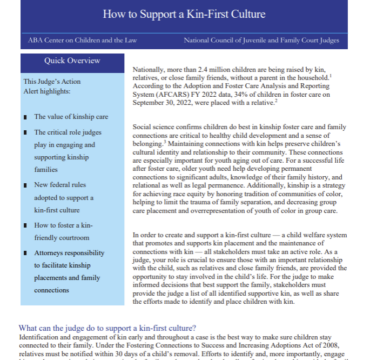
This Judge’s Action Alert highlights: benefits of parent–resource parent partnerships key elements of successful parent–resource parent partnerships how parent partners can help bridge the gap between parents and resource parents how judges can support parent–resource parent partnerships;…
Trauma responsive courts embrace a universal precaution model, which assumes that all children, families, and court stakeholders could have a history of exposure to trauma prior to court involvement. In collaboration with the National Child…
In 2019, the National Council of Juvenile and Family Court Judges (NCJFCJ) received funding support from the State Justice Institute (SJI) to manage the Children and Opioids in State Courts Project. The project design included…
In 2019, the National Council of Juvenile and Family Court Judges (NCJFCJ) received funding support from the State Justice Institute (SJI) to work with juvenile and family courts across the country to address the effects…
The St. Louis County Indian Child Welfare Act (ICWA) Court in Duluth, Minnesota, currently led by Judge Sally Tarnowski, is a dedicated docket of child welfare hearings involving Indian children as confirmed or presumed by…
Today’s social media and online landscape provides access to information, education, and connection that we could not have imagined even a decade ago. In addition to all of the instant connections that social media facilitates,…