The National Council of Juvenile and Family Court Judges (NCJFCJ) developed this resource center to provide new and experienced judicial officers and courts with the tools they need to enhance their ability to address these challenging cases. This toolkit is organized by topic and includes Understanding the Scope of the Problem, Interpreting the Legal Landscape, Implementing Promising Practices, and Leveraging Judicial Leadership. The Resource Center was developed with the support of the NoVo Foundation, Rights4Girls, National Immigrant Women’s Advocacy Project (NIWAP) Awaken, National American Indian Court Judges Association (NAICJA), and consultants Honorable John Romero (Ret.) and Toni McKinley, MA, LPC.

Resource Center for Courts on Child Sex Trafficking
Trafficking occurs every day across the U.S. and can happen to any child. Children involved in child welfare and the juvenile justice system are particularly vulnerable to becoming victims. As laws and systems change to identify and recognize sex trafficking as child abuse and victimization, processes to respond adequately to the specialized and complex needs of this population are critical to the NCJFCJ. The NCJFCJ believes juvenile and family court judges play an important role in identifying child sex trafficking victims. Together, community and systems collaboration can better serve victimized children.
Our Policy
Through a resolution adopted by the NCJFCJ Board of Directors in February 2013, the NCJFCJ opposes the criminalization of victims of child sexual exploitation and supports state laws and policies that are in line with the federal definition of a minor victim of human trafficking. What is the definition of human trafficking under U.S. federal law? The Trafficking Victims Protection Act of 2000 (TVPA) defines “severe forms of human trafficking” as: The recruitment, harboring, transportation, provision, or obtaining of a person for • sex trafficking in which a commercial sex act is induced by force, fraud, or coercion, or in which the person induced to perform such act has not attained 18 years of age; or • labor or services, through the use of force, fraud, or coercion for the purpose of subjection to involuntary servitude, peonage, debt bondage, or slavery. Coercion includes threats of physical or psychological harm to children and/or their families. Any child (under the age of 18) engaged in commercial sex is a victim of trafficking.
The NCJFCJ promotes the development of specialized services and resources for victims of child sex trafficking from the child welfare system, the juvenile justice system, and within the community at large. These services should include, but not be limited to, the development of non-detention triage facilities and specialized placement options that are equipped to address effectively the unique trauma suffered by victims of child sex trafficking.
Our Vision
The NCJFCJ is committed to a future where children who are the victims of sex trafficking are identified as victims and provided appropriate trauma-informed services. Judges should be well educated about child sex trafficking to be better informed in their decision making and take a leadership role in communities to coordinate responses to domestic child sex trafficking.


The Role of the Court in Empowering Youth Survivors of Sex Trafficking Series Events
- Understanding the Scope of the Problem
- Interpreting the Legal Landscape
- Implementing Promising Practices
- Leveraging Judicial Leadership
The Role of the Court in Empowering Youth Survivors of Sex Trafficking Series Events
Key Definitions and Resources
Understanding the Scope of the Problem
Definition of Human Trafficking
The Trafficking Victims Protection Act of 2000 and its subsequent reauthorizations define human trafficking as:
- Sex trafficking in which a commercial sex act is induced by force, fraud, or coercion, or in which the person induced to perform such act has not attained 18 years of age; or
- The recruitment, harboring, transportation, provision, or obtaining of a person for labor or services, through the use of force, fraud, or coercion for the purpose of subjection to involuntary servitude, peonage, debt bondage, or slavery. (22 U.S.C. § 7102(9)).
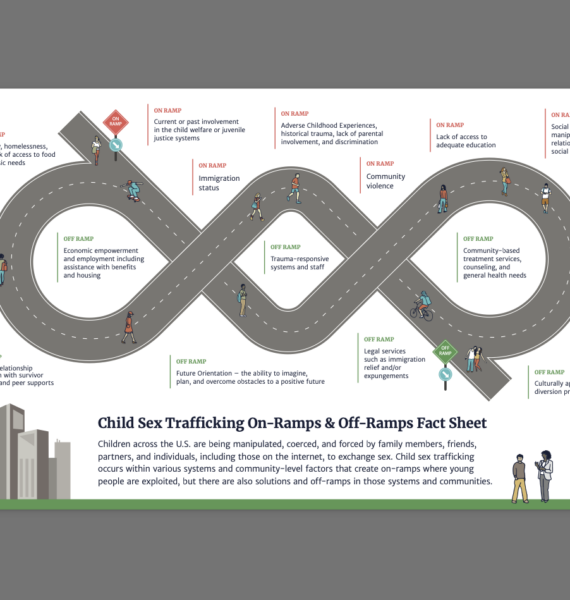
Child Sex Trafficking On-Ramps and Off-Ramps Fact Sheet
This infographic and fact sheet were developed in conversation with youth survivors and 39 stakeholders who provide training and/or technical assistance on child sexual exploitation, and youth interventions across the country. These resources are intended to help courts and community stakeholders understand the common on-ramps into the life of trafficking and the most significant off-ramps for children who are being trafficked.
The purpose of this Facilitation Guide is to provide judges with guidance on how to convene a group of court and community stakeholders to address child sex trafficking on a local level. The guide is intended to help courts and community stakeholders understand and discuss what puts minors at risk for sexual exploitation, also known as on-ramps into the life of trafficking.
What Should Judicial Officers Know About Domestic Child Sex Trafficking?
An NCJFCJ factsheet. Judicial Officers are likely to come in contact with children who are being sex trafficked. Learn more about the statistics of encountering a youth who is being sex trafficked in this report.
Who is Susceptible to Domestic Child Sex Trafficking and What Are Some Red Flags?
An NCJFCJ factsheet on the common myths and misconceptions of trafficked youth.
What We Know About How Child Sex Trafficking Happens
Developed by Polaris. A quick guide to understanding the methods through which traffickers manipulate children. By understanding the methods employed by traffickers it is easier to recognize trafficking situations.
This journal article by Dr. Ginny Sprang and Dr. Jennifer Cole describes the conditions through which children are trafficked by family members as well as the impact of family trafficking on child wellbeing. This study can help communities identify and provide effective responses for children who are trafficked for sex by family members.
Familial Trafficking Warning Signs
Shared Hope International. Factsheet on warning signs of familial trafficking.
The Juvenile Justice System and Domestic Child Sex Trafficking
Rights4Girls – Defining domestic child sex trafficking and the charges youth who are being trafficked are arrested for.
Child Welfare and Domestic Child Sex Trafficking
Rights4Girls – A brief statistical breakdown of why young people in the child welfare system are more likely to be trafficked for sex.
At-Risk for Sex Trafficking: You who Run Away From Foster Care
Developed by the Capacity Building Center for States. Examines what states and counties can learn from data in their child welfare case management systems and reported in the Adoption and Foster Care Analysis and Reporting System (AFCARS) about youth who run away from State custody, how data can be used to learn more about this high-risk population, and how this knowledge can inform interventions.
Domestic Child Sex Trafficking and Black Girls
Rights4Girls – A disproportionate number of Black girls are being trafficked for sex. Learn some of the systemic factors that put Black girls in greater danger of sex trafficking.
Racial & Gender Disparities in the Sex Trade
Rights4Girls – There are race and gender disparities in who is being trafficked for sex and who is buying sex. Learn more about the statistics in this report.
Online Child Sexual Exploitation: Prevalence, Process, and Offender Characteristics
Journal article by Dr. Juliane Kloess, Dr. Anthony Beech, and Dr. Leigh Harkins describing the process of online sexual exploitation of children. This article also describes the characteristics of groomers and other internet perpetrators.
Shining Light on the Commercial Sexual Exploitation of Children: A Toolkit to Build Understanding
Developed in partnership with the Office of Juvenile Justice Delinquency Prevention, Youth Collaboratory, and Wichita State University Center for Combating Human Trafficking, this toolkit is a resource for multidisciplinary professionals, policymakers, volunteers, faith communities, and others involved in anti-trafficking work. It provides information on a variety of topics related to human trafficking with a specific focus on mentoring for commercial sexual exploitation victims.
Interpreting the Legal Landscape
Legal Rights & Protections of Immigrant Children
What Should Judges Know About Federal, Tribal, and State Domestic Child Sex Trafficking Legislation?
An overview of Federal, Tribal, and State laws pertinent to judges presiding over domestic child sex trafficking cases.
Report Cards on Child & Youth Sex Trafficking: Enhanced Legal Framework
Shared Hope’s enhanced legal framework for state laws to protect children of sex trafficking, can be found here. This legal framework is the basis of their state report cards found here. The state report cards include an overall grade for the state’s laws as well as a law analysis. To access a specific state’s report card and law analysis, click on the state within the map.
Implementing Promise Practices
What Everyone Ought to Know About Starting a Child Sex Trafficking Youth Advisory Board
Any work that strives to serve and advocate for survivors of child sex trafficking should always provide a seat at the table for survivors, particularly youth survivors. One way to incorporate youth voice is by starting a Youth Advisory Board (YAB). A YAB provides youth and organizations the chance to work with one another in a safe and structured manner. This publication, written in coordination with the NCJFCJ YAB, provides tip and guidelines to help start and sustain a YAB for survivors of child sex trafficking.
Resources and legal requirements intended to protect children and youth in the child welfare system from human trafficking. The Information Memorandum includes and over of federal statues and highlights the resources and guidance to meet those requirements.
Creating a Human Trafficking Strategic Plan to Protect and Heal Native Children and Youth
NCJFCJ in partnership with the U.S. Department of Justice, Office of Juvenile Justice and Delinquency Prevention. Children, in particular, children in Indian Country are especially vulnerable to human trafficking. This worksheet provides guidance for tribal courts in developing a strategic plan.
The National Advisory Committee on the Sex Trafficking of Children and Youth in the United States recommendations for training, policy and procedures, implementation, data and evaluation, and funding and sustainability across 11 categories. This serves as a blueprint for how communities and states can develop a collaborative systemic response to child sex trafficking.
Human Trafficking and Child Welfare: A Guide for Child Welfare Agencies
Guidance for child welfare agency leadership on supporting children who have been trafficked for sex or are at risk of being trafficked for sex. This resources also includes information on the legal requirements child welfare agencies must uphold regarding children who are or are at risk of becoming trafficking victims.
Memorandum Summarizing the Available Screening Tools to Identify Commercially Sexually Exploited Children (CSEC)
Developed by the West Coast Children’s Clinic. A matrix and memorandum describing all the tools that are available to identify commercially sexually exploited children.
A study of the implementation of Safe Harbor laws found that the laws increase the number of youths being screed for sex trafficking and being referred to services. The study also revealed that judges and state agency personnel need more training on how to manage and respond to youth victims of sex trafficking and need to collaborate more across agencies.
Capacity Building Webinars for Human Trafficking Service Providers
Office for Victims of Crime Training and Technical Resources Center. A series of recorded webinars and best practices in addressing the needs of human trafficking survivors. It Includes webinars on how to use assessment tools.
Leveraging Judicial Leadership
Resolution Regarding Domestic Child Sex Trafficking and Commercial Sexual Exploitations of Children
A resolution adopted by the NCJFCJ Board of Directors in February 2013 and revised and adopted in March 2016 committing to a future where children who are the victims of sex trafficking are identified as victims and provided appropriate trauma-informed services.
The National Judicial Institute on Domestic Child Sex Trafficking (NJIDCST)
Training for judges that address the serious issue of child sex trafficking in the United States. Developed in partnership with the U.S. Department of Justice, Office of Juvenile Justice, and Delinquency Prevention and Rights4Girls. This institute provides judges with a highly interactive educational opportunity to expand their knowledge of trafficking risk factors, victim identification, effective intervention strategies, cultural considerations, and much more.
The National Child Traumatic Stress Network NCTSN Bench Cards for the Trauma-Informed Judge
Developed in partnership with the Substance Abuse and Mental Health Services Administration, the U.S. Department of Health and Human Services. These bench cards aid judicial officers in asking trauma-informed questions, developing a clearer picture of childhood trauma in order to assess needs, and considering trauma as decisions are made regarding a child’s home placement.
Developed in collaboration with the NCJFCJ, the National Center for Missing and Exploited Children (NCMEC), and the U.S. Department of Justice, Office of Juvenile Justice and Delinquency Prevention. The focus of this publication is on judicial action that ensures a coordinated response.
Voices from the Bench: Judicial Perspectives on Handling Child Sex Trafficking Cases
the National Council of Juvenile and Family Court Judges (NCJFCJ) in partnership with the U.S. Department of Justice, Office of Juvenile Justice and Delinquency Prevention. This publication focuses on judicial leadership efforts all over the country that have shifted how the court responds to DCST.
OVC Enhancing Juvenile & Family Court Responses to Human Trafficking
The Office for Victims of Crime, U.S. Department of Justice (OVC) funded this initiative to develop or enhance programs to provide direct services and diversion programs for youth in contact with the juvenile and family court systems who are victims of sex and/or labor trafficking or at risk for human trafficking due to past or current crime victimization, including child abuse and neglect. NCJFCJ is the training and technical assistance provider supporting the implementation of best practices, collaboration, and improved outcomes for program sites funded under this initiative.
OVC Field Generated Strategies to Address the Criminalization of Minor Victims of Sex Trafficking
The OVC funded Field Generated Strategies to Address the Criminalization of Minor Victims of Sex Trafficking provides training and technical assistance for court and community collaborators to generate strategies to end the criminalization of minor victims of sex trafficking and to develop, expand, and strengthen victim service programs to support victim-centered, trauma-informed, developmentally appropriate, and evidence-based responses to minor victims of sex trafficking.
Promising Practices in Juvenile and Family Courts to Address Child Sex Trafficking – NoVo Foundation
Funded by the NoVo Foundation, the Promising Practices in Juvenile and Family Courts to Address Child Sex Trafficking projectseeks to close the on-ramps to commercial sexual exploitation for youth by addressing conditions in the juvenile and family justice system that continue to foster trafficking.

National Judicial Institute on Domestic Child Sex Trafficking
The National Judicial Institute on Domestic Child Sex Trafficking (NJIDCST) offers training programs for judges that address the serious issue of child sex trafficking in the United States. Created in partnership with the U.S. Department of Justice, Office of Juvenile Justice and Delinquency Prevention, and Rights4Girls in 2014, the Institute provides judges with a highly interactive educational opportunity to expand their knowledge of trafficking risk factors, victim identification, effective intervention strategies, cultural considerations, and much more. The Institute aims to instill a stronger sense of judges’ courtroom and community roles to help prevent and end domestic child sex trafficking.
Recently, the NJIDCST integrated a special segment titled “Judges Can.” “Judges Can” focuses on the real-world practical applications of the curriculum, which covers eight independent topical areas such as victim and perpetrator behavior, trafficking dynamics, culture, judicial decision-making, and the legal landscape of trafficking law. “Judges Can” allows participants to take a step back after each segment and explore how they can make immediate changes to their own judicial practice from the moment they return to their courtroom. By drawing upon the experience of some of the best and brightest judicial experts in the country, the NJIDCST helps judicial officers understand the steppingstones behind crafting a strong, sustainable response to child sex trafficking cases. “Judges Can” answers complex questions for judges like How do you talk to a child who has experienced trauma? How do you create a trafficking task force? What is the best intervention for dual jurisdiction youth? If you are a judicial officer who is looking for practical ways to respond to sex trafficking in your jurisdiction, we hope you will consider attending the next NJIDCST training.
National Judicial Institute on Domestic Child Sex Trafficking
Faculty Spotlights
Each NJIDCST program is led by a faculty team of experienced judges and other experts from across the country who have pioneered work on domestic child sex trafficking in the courtroom and beyond.
Judge Catherine Pratt
Succeeding Through Achievement and Resilience (STAR) Court, Los Angeles Superior Court
Judge Pratt has been an integral faculty member of the National Judicial Institute on Domestic Child Sex Trafficking since its inception in 2014. Judge Pratt brings a high level of expertise to the Institute rooted in her experience in the STAR Court, a collaborative, victim-centered court that provides services to juveniles who have been commercially sexually exploited and are on probation for prostitution or related charges.
Judge Pratt was appointed as a commissioner in the Los Angeles Superior Court in 2006 and became a judge in 2016. She has been assigned to the juvenile delinquency court since July 2007 and in January 2012 began supervising the STAR Court.
Judge Pratt received a B.S. from the University of California at Berkeley and a J.D. from the University of Southern California. She practiced law in the private sector, representing Wall Street firms, for ten years both in Los Angeles and San Francisco. She then worked in the Los Angeles dependency court, representing the Department of Children and Family Services. While at the County Counsel’s Office she also handled several class actions involving the adequacy and delivery of services by DCFS.
Click here to see Judge Pratt’s court featured in a video by the Compton Business Journal.
Click here to read a Los Angeles Times article on the STAR Court.
Judge John J. Romero, Jr.
Children’s Court Division of the Second Judicial District Court of New Mexico and the Program for the Empowerment of Girls (PEG)
Judge John Romero, Jr. has also been a valued faculty member of the Institute since 2014. Judge Romero offers his extensive knowledge on the role of the judiciary in responding to child trafficking along with his excellent facilitator skills to both educate and engage Institute participants on this important issue.
Judge Romero is the Presiding Judge of the Children’s Court Division of the Second Judicial District Court in Albuquerque, New Mexico. Judge Romero also serves as a Therapeutic Court Judge for the Program for the Empowerment of Girls (PEG), an intensive multi-agency juvenile probation program for girls who have some type of violence in their history. Judge Romero began his tenure on the bench in 2003 as a District Court Judge. He is Co-Chair Emeritus of the Children’s Court Improvement Commission, a past member of the New Mexico Tribal-State Judicial Consortium, serves on the Board of Directors of the National Council of Juvenile and Family Court Judges, and served on the Resource Guidelines: Improving Court Practice in Child Abuse and Neglect Cases Revision Committee. He is a frequent trainer on issues related to juvenile justice and child welfare. He is a graduate of the University of New Mexico School of Law.
Yasmin Vafe, JD
Executive Director of Rights4Girls
Yasmin Vafa has been a key faculty member and partner of the Institute from the very beginning. At each Institute, Yasmin shares her in-depth understanding of the issue of domestic child sex trafficking in the U.S., with a particular focus on the legal landscape.
Yasmin is the co-founder and Executive Director of Rights4Girls, a human rights organization working to end gender-based violence against young women and girls in the U.S. Her work and advocacy focus on the intersections between race, gender, violence, and the law. She speaks widely on these issues and educates the public and policymakers on how they affect the lives of marginalized women and girls. Yasmin has achieved several policies wins at the federal level, co-authored a seminal report mapping girls’ unique pathways into the juvenile justice system, and was the 2016 recipient of the Lois Haight Award of Excellence and Innovation from the Congressional Victims’ Rights Caucus. Prior to her work at Rights4Girls, Yasmin served as Acting Refugee Coordinator for Amnesty International Australia where she led the organization’s refugee advocacy and shifted national policy on the mandatory and indefinite detention of asylum seekers in the region. She received her B.A. from Boston University and earned her J.D. from the University of Florida, Levin College of Law.
Read Yasmin’s Huffington Post blog.
Learn about Rights4Girls’ No Such Thing as a Child Prostitute campaign.
National Judicial Institute on Domestic Child Sex Trafficking Online Resources
IDENTIFYING VICTIMS:
- Blue Campaign, Department of Homeland Security. What Can You Do? Recognizing and Supporting Victims in the Courtroom.
- King County CSEC Task Force. Warning Signs a Child is at Risk for Commercial Sexual Exploitation.
- Shared Hope International. Warning Signs of Sex Trafficking.
ISSUE BRIEFS & FACT SHEETS:
- Rights4Girls. Fact Sheet: Child Welfare and Domestic Child Sex Trafficking.
- Rights4Girls. Fact Sheet: Domestic Child Sex Trafficking and the Juvenile Justice System.
- Rights4Girls. Issue Brief: Dual System/Cross Over Youth and Trafficking.
- Demand Abolition. Key Facts About Preventing Trafficking Victimization Through “Demand Reduction.”
- National Child Traumatic Stress Network. (2017). Understanding and Addressing Trauma and Child Sex Trafficking.
NCJFCJ PUBLICATIONS & WEBINARS:
- Bohannan, T., Cullen, C., Devault, A., Ely, C., Siegel, G., and Trescher, S. (2019). Voices from the Bench: Judicial Perspectives on Handling Child Sex Trafficking Cases. National Council of Juvenile and Family Court Judges.
- NCJFCJ (2015). Creating a Human Trafficking Strategic Plan to Protect and Heal Native Children and Youth.
- NCJFCJ (2015). Domestic Child Sex Trafficking: Crisis at a Crossroads.
- NCJFCJ (2016). Enhanced Resource Guidelines: Improving Court Practice in Child Abuse and Neglect Cases.
- NCJFCJ (2015). Missing Children, State Care, and Child Sex Trafficking: Engaging the Judiciary in Building a Collaborative Response.
TOOLS & BENCHCARDS:
- Center for Court Innovation. (2015). Responding to Sex Trafficking in Your Jurisdiction: A Planning Toolkit.
- Connecticut Department of Children & Families. Domestic Minor Sex Trafficking Decision and Practice Map.
- National Human Trafficking Hotline website, includes National Human Trafficking Referral Directory, National Hotline Statistics, and other resources.
- NCTSN & NCJFCJ. NCTSN Bench Card for the Trauma-Informed Judge and NCTSN Bench Card for Court-Ordered Trauma-Informed Mental Health Evaluation of Child: Sample Addendum.
- NCJFCJ. (2010). The CCC Preliminary Protective Hearing Benchcard: A Tool for Judicial Decision-Making.
- Supreme Court of Ohio. (2017). Juvenile Human Trafficking, Ohio Laws & Safe Harbor Response.
SAMPLE COURT ORDERS:
- Sample Court Order to Report Missing Child
EXAMPLE PROTOCOLS:
- Center for Children & Youth Justice. (2013). Washington State Model Protocol for Commercially Sexually Exploited Children.
- Connecticut Department of Children & Families. Description of the Specialized Foster Care Model for CSEC Victims and High-Risk Youth.
- Connecticut Department of Children & Families. Practice Guide for Intake and Investigative Response to Human Trafficking of Children.
- Connecticut Department of Children & Families. (2008). Program Guidelines for Girls’ Services in Connecticut (2008).
- Florida Department of Juvenile Justice. (2015). Human Trafficking Procedures.
- Los Angeles County. Law Enforcement First Responder Protocol for Commercially Sexually Exploited Children.
- Ramsey County Attorney’s Office, Minnesota and the Sexual Violence Justice Institute. (2017). Safe Harbor Protocol Guidelines.
SPECIALTY COURTS:
- Liles, B., et al. (2016). A California Multidisciplinary Juvenile Court: Serving Sexually Exploited and At-Risk Youth.
- Los Angeles Superior Court. (2016). STAR Court Protocol (Draft).
- Second Judicial District, Children’s Court Division, Albuquerque, NM. Program for the Empowerment of Girls Information Pamphlet.
RESEARCH & REPORTS:
- Arizona State University, Office of Sex Trafficking Intervention Research. (2017). A Six-year Analysis of Sex Traffickers of Minors: Exploring Characteristics and Sex Trafficking Patterns.
- Bureau of Justice Statistics. (2017). Special Report: Federal Prosecution of Commercial Sexual Exploitation of Children Cases, 2004-2013.
- Cook County Sheriff’s Office. (2017). Buyers and Sellers: A Window into Sex Trafficking Report.
- Countryman-Roswurm, K., & Shaffer, V. (2015). It’s More Than Just My Body That Got Hurt: The Psychophysiological Consequences of Sex Trafficking.
- Edelman, P., & Epstein, R. (2014). Blueprint: A Multidisciplinary Approach to the Domestic Sex Trafficking of Girls.
- Farley, M., et al. (2011). Garden of Truth: The Prostitution and Trafficking of Native Women in Minnesota.
- Institute of Medicine and National Research Council of the National Academies. (2013). Confronting Commercial Sexual Exploitation and Sex Trafficking of Minors in the United States.
- NCAI Policy Research Center. (2016). Human Trafficking: Trends and Responses across Indian Country.
- Pilnik, L. & National Network for Youth. (2018). Responding to Youth Homelessness: A Key Strategy for Preventing Human Trafficking.
- Rights4Girls. (2018). Survivor Protection: Reducing the Risk of Trauma to Child Sex Trafficking Victims.
- Saada Saar, M., et al. (2015). The Sexual Abuse to Prison Pipeline: The Girls’ Story.
- Serita, T. (2013). In Our Own Backyards: The Need for a Coordinated Judicial Response to Human Trafficking.
- Shively, M., et al. (2012). The National Institute of Justice Report: A National Overview of Prostitution and Sex Trafficking Demand Reduction Efforts.
- Shared Hope International (2015). Justice for Juveniles: Exploring Non-Criminal Response Mechanisms for Child Sex Trafficking.
- WestCoast Children’s Clinic. (2012). Research to Action: Sexually Exploited Minors (SEM) Needs and Strengths.
- Williams, R. (2017). Safe Harbor: State Efforts to Combat Child Trafficking.
LEGAL ANALYSIS:
- Detailed Summary of H.R. 4980, the ‘Preventing Sex Trafficking and Strengthening Families Act.’
- Rights4Girls. Preventing Sex Trafficking and Strengthening Families Act, Public Law No. 113-183.
- Shared Hope International (2016) Protected Innocence Challenge: 2016 End of Year Legislative Progress Report.
TRAINING CURRICULA:
- ASU School of Social Work, Office of Sex Trafficking Intervention Research. What You Need to Know: Sex Trafficking and Sexual Exploitation – A Training Tool for Child Protective Service
- ASU School of Social Work, Office of Sex Trafficking Intervention Research. What You Need to Know: Sex Trafficking and Sexual Exploitation – A Training Tool for Adult Probation Officers.
- Connecticut Department of Children & Families. Domestic Minor Sex Trafficking and Commercial Sexual Exploitation of Children MDT Training Presentation.
- LOVE146. Not a #Number Curriculum.
- My Life My Choice. Preventing the Exploitation of Girls: A Groundbreaking Curriculum.
MAINSTREAM MEDIA ARTICLES:
- Brown, P. (January 28, 2014). A Court’s All-Hands Approach Aids Girls Most at Risk. The New York Times.
- Kemp, K. (September 9, 2016). Sex Trafficking and Abuse in the Marijuana Industry: An Investigation Centered in Humboldt.
- Plaza, K. (May 29, 2017). How LA County Began to Face Its Big Problem with Youth Being Sex Trafficked. Youth Today.
- Smith, M., Walters, E., & Satija, N. (February 16, 2017). She Was a Sex-Trafficking Victim, but Texas Law Labeled her a Pimp. Texas Tribune.
- Therolf, G. (October 10, 2014). “L.A. County reaching out to save children from prostitution.” Los Angeles Times.
AUDIO & VIDEO RESOURCES:
- American RadioWorks. (2016). Bought and Sold: The New Fight Against Teen Sex Trafficking.
- Rights4Girls, No Such Thing
- Withelma “T” Ortiz Walker Pettigrew’s Testimony Before Congress on Sex Trafficking and Children in Foster Care
- https://www.youtube.com/watch?v=aTAVZChvLR4&t=5s
- https://www.youtube.com/watch?v=WZIf_4Eg7_Y
The National Judicial Institute on Domestic Child Sex Trafficking is a partnership of the National Council of Juvenile and Family Court Judges, Rights4Girls, and the U.S. Department of Justice, Office of Juvenile Justice and Delinquency Prevention.
The statements and positions contained within these resources do not represent official positions of NCJFCJ, Rights4Girls, or the OJJDP, and are solely those of the author, or authoring organization. For more information on NCJFCJ’s policies and positions, please review official NCJFCJ publications and resolutions available on this website.
For additional information on these and other publications, or for any training or technical assistance needs, please contact us.
National Judicial Institute on Domestic Child Sex Trafficking Research Reports
Various NJIDCST research reports have been developed based on participant evaluations from the following Institutes:
- September 2018 – Houston, TX
- August 2018 – Portland, OR
- February 2018 – Asheville, NC
- June 2017 – San Diego, CA
- March 2017 – Austin, TX
- September 2016 – Washington, D.C.
- May 2016 – Reno, NV
- November 2014 – Reno, NV
A follow-up survey was also conducted among 34 participants of 5 Institutes. The following report summarizes their responses regarding the application of knowledge gained during the Institutes.
The NCJFCJ’s National Center for Juvenile Justice (NCJJ) staff conducted an analysis of the data collected over time in order to understand the cumulative performance of the seven training events (2014-2018) containing a total of 134 participants. The analysis centered around ~17 of the Likert Scale and Ordinal measures common between these institutes, including 15 areas of knowledge, satisfaction, and number of identified risk factors.
Contact Information
Please reach out to contactus@ncjfcj.org or (775) 507-4777 with any questions.
Contact Us
This project is supported by Grant No. 2018-CT-FX-K001 awarded by the Office of Juvenile Justice and Delinquency Prevention, U.S. Department of Justice. The opinions, findings, conclusions, and recommendations expressed on this webpage are those of the author(s) and do not necessarily reflect the views of the Office of Juvenile Justice and Delinquency Prevention, U.S. Department of Justice or the National Council of Juvenile and Family Court Judges.